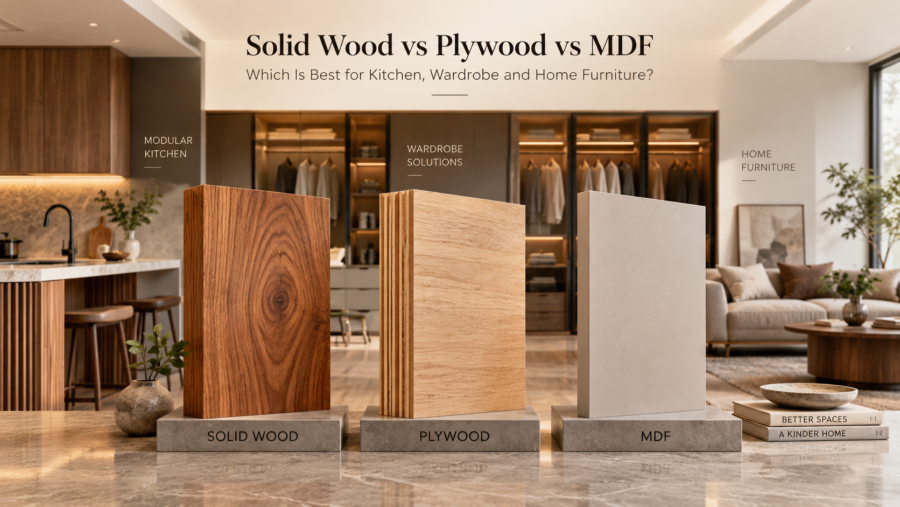
A beautiful laminate or veneer can hide a poor core material. Before starting wardrobes or a modular kitchen, homeowners should understand the practical difference between solid wood, plywood and MDF.
Solid Wood
Natural solid wood offers premium appearance, repairability and long life when properly seasoned and protected. It is excellent for doors, frames and furniture, but can be expensive and may move, warp or crack if moisture content and seasoning are poorly controlled.
Plywood
Plywood is made from cross-laminated wood veneers. Good-quality plywood offers useful screw holding and dimensional stability, making it common for kitchens, wardrobes, beds and cabinets.
Grade matters. Areas exposed to moisture need a board appropriate for that exposure; a decorative surface alone does not make the core waterproof.
MDF
MDF has a smooth uniform surface that works well for painted panels, routed designs and some dry-area furniture. Standard MDF is less suitable where repeated moisture exposure or heavy screw loading is expected unless a suitable grade and detailing are used.
Which Material Where?
- Kitchen carcass: good-quality plywood is a common practical choice; specify grade and thickness.
- Wardrobes: plywood, MDF or engineered boards depending on budget and design.
- Painted shutters: MDF can give a smooth routed/painted finish in suitable conditions.
- Door frames: solid wood or engineered alternatives as specified.
- Heavy shelves: check span, thickness, edge support and fasteners—not material name alone.
7 Checks Before Carpentry Starts
- Write board brand, grade and thickness in the contract.
- Ask to see core material before laminate covers it.
- Seal exposed edges properly.
- Plan hardware and load requirements.
- Keep woodwork away from active wet construction.
- Complete plumbing leak tests first.
- Use suitable fasteners for each board type.
Final Answer
Solid wood offers natural premium character, plywood is a versatile structural board for many cabinets, and MDF is useful for smooth decorative work in suitable dry applications. The best choice depends on location, moisture, load, finish and budget—not just the carpenter’s preferred material.
Planning Your Home Construction?
Get a clear construction scope, material specification and stage-wise execution plan before work starts.
WhatsApp: +91 84488 02364