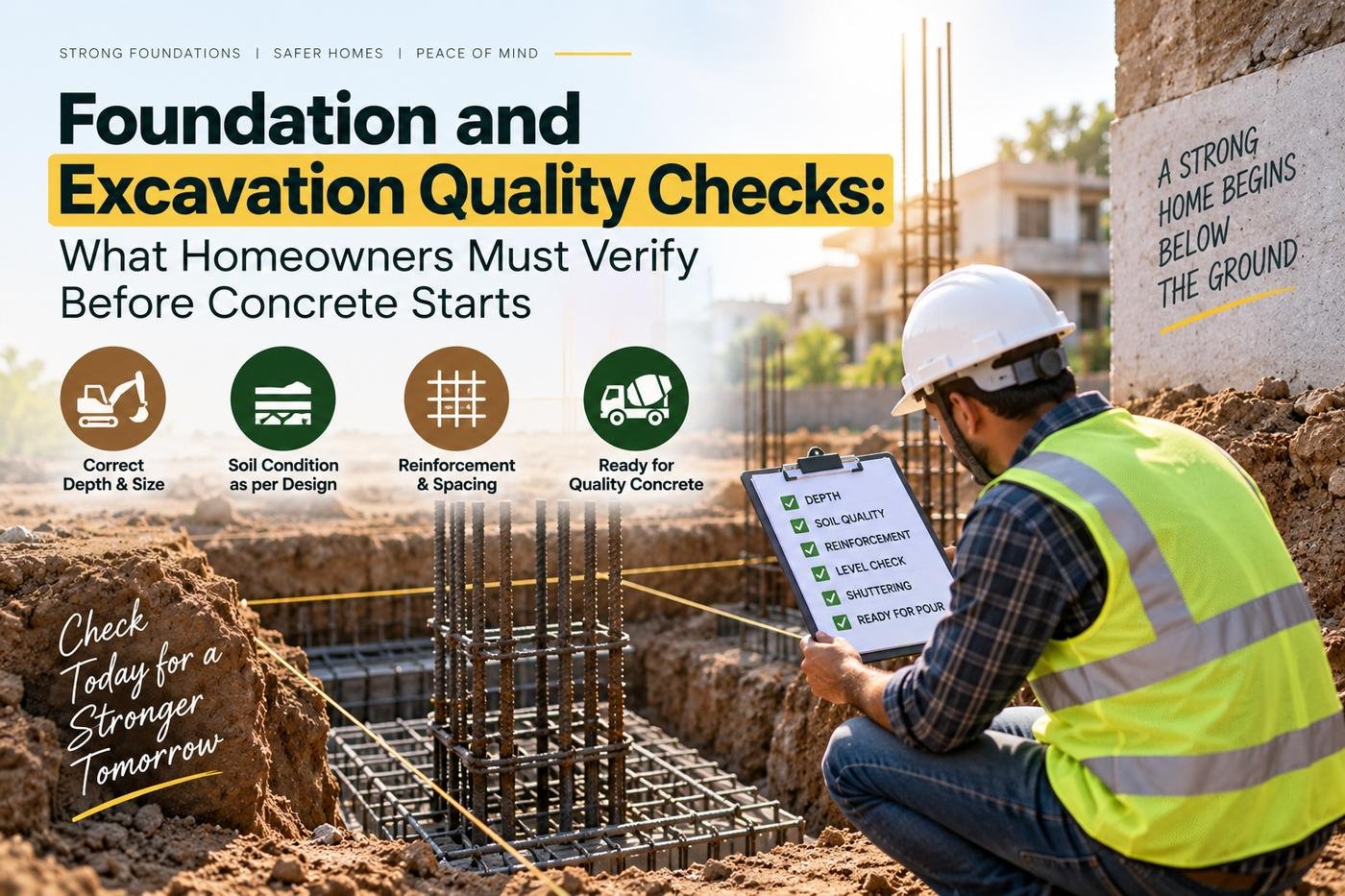
Foundation work disappears below the ground, which is exactly why mistakes at this stage are dangerous. Once columns rise and backfilling is complete, many early defects become difficult to inspect or correct.
For a plot owner, the goal is not to calculate footing sizes personally. The goal is to make sure excavation and foundation work follow approved drawings, site conditions, and proper quality checks before concrete is poured.
This guide explains what homeowners should verify at each early stage and which decisions must stay with the structural engineer.
Table of Contents
- Why Foundation Checks Matter
- Before Excavation Starts
- Excavation Depth and Soil Condition
- PCC and Base Preparation
- Reinforcement Before Concrete
- Cover, Spacing and Supports
- Formwork and Alignment
- Concrete Pour Checklist
- Backfilling and Plinth
- Common Red Flags
- Conclusion
Why Foundation Checks Matter
Every load from the house eventually reaches the foundation. If excavation level, soil condition, footing position, reinforcement, or concrete execution is wrong, the effect can continue into the entire structure.
Before Excavation Starts
- Confirm plot boundaries and benchmarks.
- Check the approved column/footing layout.
- Confirm excavation reference level.
- Identify underground utilities or existing structures.
- Ensure structural drawings are available at site.
A layout error at this stage can shift columns, setbacks, rooms, or boundary clearances.
Excavation Depth and Soil Condition
The required depth is not a universal number. It depends on structural design and site conditions.
During excavation, unexpected loose soil, filled soil, water seepage, old foundations, or cavities should be reported to the engineer before continuing.
Do Not Ignore
- Sudden change in soil layer
- Water collecting in footing pits
- Loose sides collapsing into excavation
- Footing pit larger or shifted from drawing
- Manual “adjustment” without engineer approval
PCC and Base Preparation
Where specified, plain cement concrete creates a clean, stable working base and helps keep reinforcement away from soil contamination.
Before PCC, the excavation base should be reasonably clean and at the intended level. Loose soil, standing water, and debris should not simply be covered.
Reinforcement Before Concrete
This is one of the most important inspection points because the steel becomes hidden after concrete placement.
- Bar diameter matches drawing
- Number of bars matches drawing
- Spacing is correct
- Footing and column bars are properly tied
- Required development/anchorage details are followed
- Bars are reasonably clean from mud and oil
Cover, Spacing and Supports
Reinforcement should not rest directly on soil or formwork where specified cover is required.
Approved cover blocks and supports help keep steel in the intended position during concrete placement. Improvised stones or broken brick pieces are not a professional substitute where proper cover blocks are required.
Formwork and Alignment
Formwork should be stable enough to hold fresh concrete without excessive movement or leakage.
- Check footing location and size against drawing.
- Verify column starter position.
- Check line and level.
- Look for large gaps that may leak cement slurry.
- Ensure work area is clean before pour.
Concrete Pour Checklist
| Before Pour | During Pour | After Pour |
|---|---|---|
| Drawing check | Controlled placement | Curing plan |
| Steel inspection | Proper compaction | Protection from damage |
| Formwork check | Avoid segregation | Record pour details |
Backfilling and Plinth
Backfilling should not be treated as simply throwing loose soil into the foundation area.
Suitable material, controlled layers, and proper compaction help reduce later settlement around floors and external areas. Plinth-level waterproofing or damp-protection details should also follow the project specification.
Common Red Flags
- Excavation changes without engineer approval
- Steel directly touching soil
- Standing water during concrete placement
- No pre-pour inspection
- Unclear concrete grade
- Column position adjusted informally
- Backfilling done without compaction control
Conclusion
The foundation stage deserves slower, more careful checking because errors become hidden quickly.
- Follow approved drawings.
- Report unusual soil conditions.
- Inspect reinforcement before concrete.
- Use proper cover and formwork.
- Document major pre-pour checks.
Need a Strong Start for Your Home Construction?
Share your plot size, location, and required floors to discuss a structured foundation-to-handover construction plan.
WhatsApp: +91 84488 02364