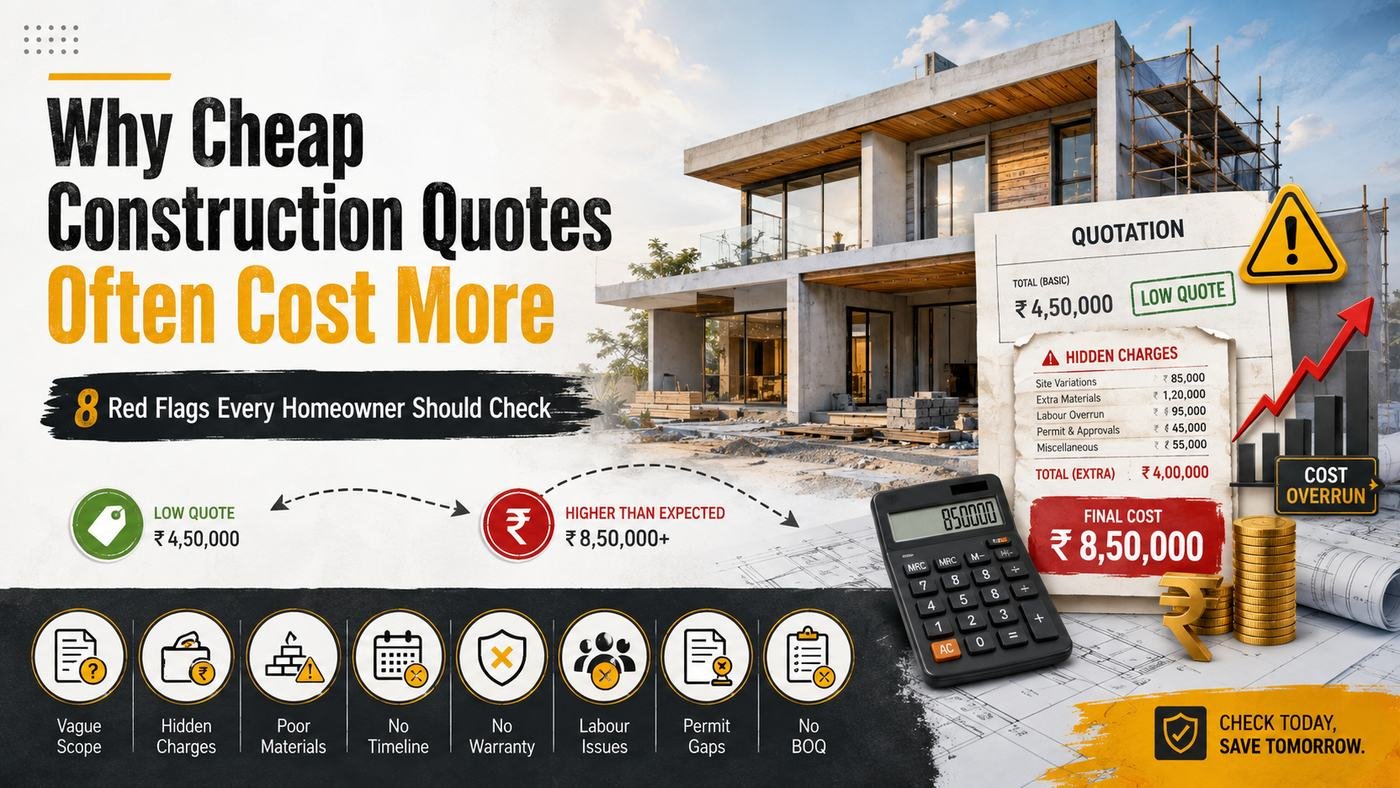
A very low construction quotation can feel like a smart saving when you are planning a new home. But for many plot owners, the cheapest quote becomes expensive only after work starts and the missing items begin to appear.
The problem is rarely the headline rate alone. It is usually the unclear scope behind that rate: excluded materials, vague specifications, separate service charges, unrealistic timelines, or extra payments that were never discussed before signing.
This guide helps homeowners identify the most common warning signs in a suspiciously cheap quote and compare contractors on total project value—not just the first number on the proposal.
Table of Contents
- Why Cheap Quotes Look Attractive
- Red Flag 1: Important Items Are Missing
- Red Flag 2: Material Specifications Are Vague
- Red Flag 3: Unrealistic Structural Allowances
- Red Flag 4: Too Many ‘Extra’ Charges
- Red Flag 5: Payment Terms Favor the Contractor
- Red Flag 6: No Clear Timeline
- Red Flag 7: No Rework Responsibility
- Red Flag 8: No Written Exclusions
- How to Compare Two Quotes Properly
- Conclusion
Why Cheap Quotes Look Attractive
Most homeowners first compare the rate per square foot. If one contractor is significantly cheaper, the immediate assumption is that the same house can be built for less.
But two quotations with the same built-up area may cover very different things. One may include structural drawings, branded materials, waterproofing, plumbing, electrical work, supervision, and debris handling. Another may include only basic civil work.
Red Flag 1: Important Items Are Missing
A quote can look low simply because major activities are not included.
- Waterproofing
- Electrical wiring or switchgear
- Plumbing fixtures
- External development
- Water and electricity arrangements
- Debris removal
- Transport or unloading
- Staircase railing or elevation work
Ask for a written inclusion and exclusion list before comparing prices.
Red Flag 2: Material Specifications Are Vague
Terms like “good quality cement,” “standard steel,” or “premium fittings” are not specifications.
A useful quotation should mention grade, brand range, thickness, or approved equivalent wherever practical. Without this, the homeowner may expect one quality level while the contractor prices another.
Check These First
- Cement brand or approved equivalent
- TMT steel grade
- Brick or block type
- Electrical wire and switch range
- Plumbing pipe specification
- Tile price allowance
- Paint system
Red Flag 3: Unrealistic Structural Allowances
Structural steel, concrete, footing sizes, beam dimensions, and slab reinforcement should not be reduced just to make a quote look cheaper.
These quantities must follow approved structural drawings and site conditions. A contractor who promises a fixed low structural quantity before understanding the design may be creating a future variation claim.
Red Flag 4: Too Many “Extra” Charges
A cheap quote can become expensive when ordinary work is treated as an extra after construction starts.
- Extra for material shifting
- Extra for curing labour
- Extra for standard scaffolding
- Extra for basic service openings
- Extra for normal site supervision
Some extras are genuine when scope changes, but routine construction activities should not come as a surprise.
Red Flag 5: Payment Terms Favor the Contractor
If a contractor asks for a very large advance before equivalent work or material is visible on site, the low quote may not reduce your financial risk.
Prefer milestone-based payments linked to measurable progress such as excavation, foundation, slab stages, masonry, services, and finishing.
Red Flag 6: No Clear Timeline
Delay has a cost. Rent, temporary accommodation, storage, loan interest, and repeated site visits can all increase when construction stretches beyond the planned timeline.
The agreement should include a realistic schedule and clearly identify what can affect it, including owner changes, approvals, weather, and material availability.
Red Flag 7: No Rework Responsibility
If plumbing, electrical, civil, and finishing teams are not coordinated, completed work may need to be broken and rebuilt.
Ask who pays when rework is caused by contractor execution error versus an owner-requested change.
Red Flag 8: No Written Exclusions
Every quotation has limits. The safer quote is the one that states those limits openly.
Items such as approvals, soil testing, lift, modular kitchen, boundary wall, borewell, landscaping, or utility connection may or may not be included. The important part is knowing this before work starts.
How to Compare Two Quotes Properly
| Compare | Do Not Check Only | Also Check |
|---|---|---|
| Price | Rate/sq.ft. | Total scope and exclusions |
| Materials | Brand name only | Grade, range, specification |
| Timeline | Verbal promise | Written milestones |
| Payment | Advance amount | Progress-linked schedule |
Conclusion
The cheapest quotation is not automatically the worst, and the highest quotation is not automatically the best. The goal is to compare complete scope, material quality, responsibility, timeline, and payment structure.
- Ask for detailed inclusions and exclusions.
- Verify material specifications.
- Do not compromise structural design to reduce cost.
- Use milestone-based payments.
- Document extra work before execution.
Want a Transparent Construction Quote for Your Plot?
Share your plot size, location, and required number of floors with The Home Construction team for a clear, scope-based quotation.
WhatsApp: +91 84488 02364