Building your own home is already a major financial commitment. The last thing a plot owner wants is to pay a large amount upfront and then spend weeks wondering whether work will actually begin on time.
Some contractors ask for heavy advance payments before excavation, material delivery, or any visible site activity. That can make homeowners uncomfortable because too much money leaves their hands before enough work has been completed.
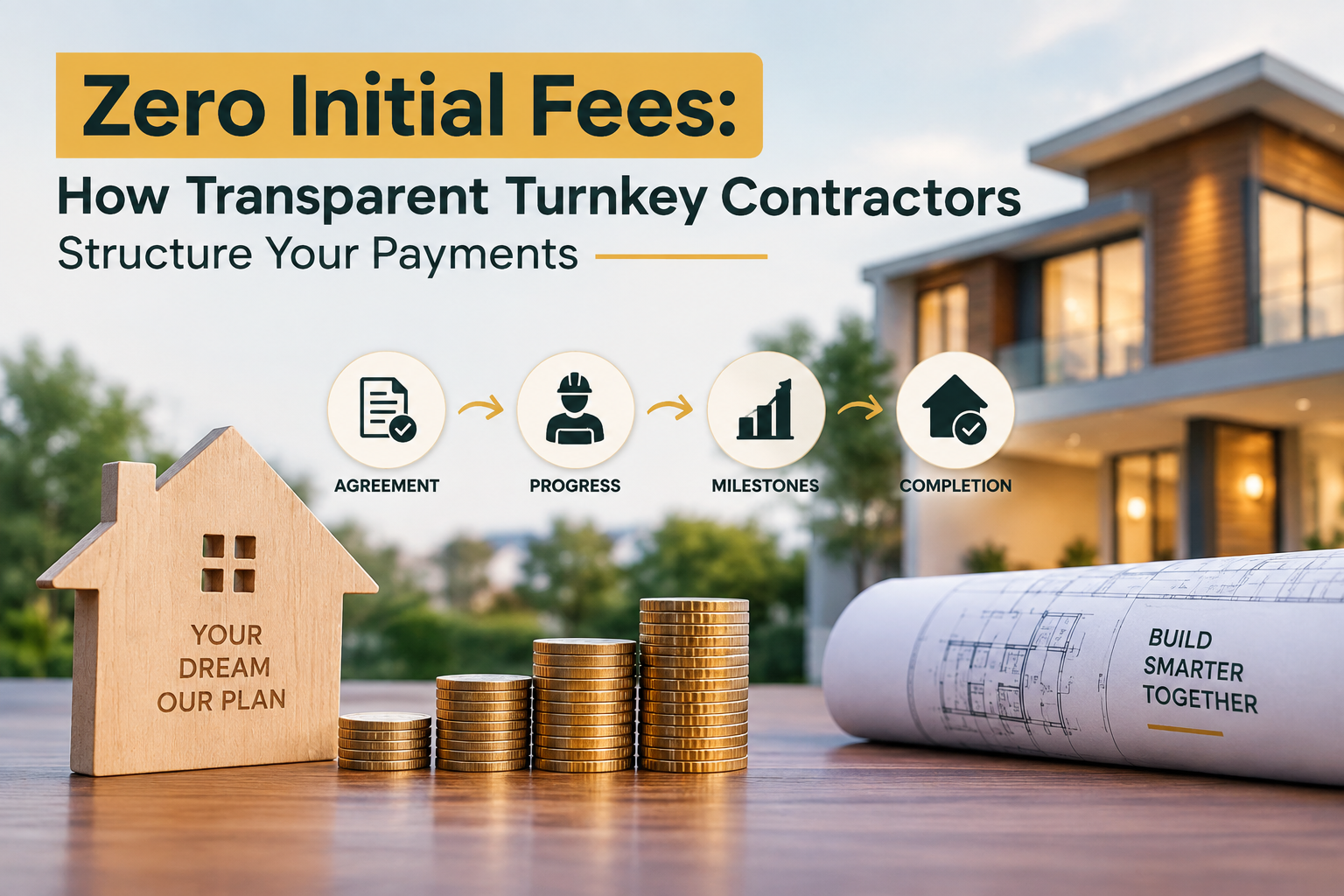
A transparent turnkey construction process should work differently. Instead of depending on a large unjustified initial fee, payments should be linked to clear construction milestones, documented scope, approved materials, and actual progress on site.
This guide explains how a safer payment structure can protect your cash flow while keeping the contractor accountable throughout your home construction project.
Table of Contents
- Why Heavy Initial Payments Can Be Risky
- What “Zero Initial Fees” Should Actually Mean
- How a Stage-Wise Payment Schedule Works
- A Practical Construction Payment Example
- What Should Be Confirmed Before the First Payment
- Material Procurement and Payment Transparency
- Warning Signs in a Contractor’s Payment Terms
- How Homeowners Can Track Every Payment
- Which Payment Structure Is Safer?
- Conclusion
Why Heavy Initial Payments Can Be Risky
A construction contractor needs working capital to mobilize labour, arrange materials, and start site operations. So an advance payment is not automatically wrong.
The problem begins when the contractor asks for a large percentage of the total project value before clearly defining what that amount will be used for.
For a Homeowner, This Creates Three Major Risks
- Too much cash gets blocked before construction progress is visible.
- The contractor has less financial pressure to complete the next stage quickly.
- If the scope is unclear, disputes can start over what was included in the advance.
What “Zero Initial Fees” Should Actually Mean
Zero initial fees should not be misunderstood as “no payment until the entire house is completed.” That would not be practical for any genuine construction company.
A better meaning is that the homeowner should not be forced to pay a heavy, unexplained setup fee before the project scope and first milestone are clear.
A Transparent Contractor Should First Define
- Total scope of work
- Approximate construction area
- Approved material specifications
- Stage-wise timeline
- Payment milestones
- Items excluded from the quotation
- Process for additional work
Only after this should the first project-linked payment become due.
How a Stage-Wise Payment Schedule Works
In a well-structured turnkey project, payments are released as construction moves from one completed stage to the next.
Instead of thinking only in terms of dates, homeowners should think in terms of completed work.
| Construction Stage | What Should Be Verified | Payment Logic |
|---|---|---|
| Planning | Scope, drawings, area, specifications | Linked to approved pre-construction work |
| Excavation & Foundation | Layout, excavation, reinforcement, base work | Release after milestone verification |
| Structure & Slabs | Columns, beams, reinforcement, slab casting | Stage-wise structural payment |
| Brickwork & Services | Walls, plumbing routes, electrical conduits | Pay against completed work |
| Finishing & Handover | Flooring, fixtures, testing, snag closure | Final stage linked to completion |
Mobile tip: Swipe left-right to view the full table.
A Practical Construction Payment Example
Imagine that your foundation work is the next milestone. Before releasing the payment linked to that stage, you should be able to confirm that the agreed activities have been completed or are ready for verified execution.
That May Include
- Excavation completed to the approved layout
- PCC or base preparation completed where applicable
- Reinforcement placed according to structural drawings
- Formwork checked before concrete work
- Required material available on site
- Engineer or site supervisor verification completed
Once the milestone is verified, the next payment can be released according to the agreement.
What Should Be Confirmed Before the First Payment
Before making the first meaningful payment, a plot owner should have more than just a verbal promise.
At Minimum, Confirm the Following
- Final or clearly defined quotation
- Construction scope in writing
- Plot dimensions and approximate built-up area
- Material specification list
- Number of floors included
- Structural and architectural responsibilities
- Payment schedule
- Expected project timeline
- Additional-work approval process
- Contractor’s contact and company details
A professional contractor should be comfortable explaining where your money will go and what progress you should expect next.
Material Procurement and Payment Transparency
Materials form a major part of home construction cost. This is why material procurement should be directly connected to the financial plan.
Major Purchases May Include
- Cement
- TMT reinforcement steel
- Bricks or blocks
- Sand and aggregate
- Waterproofing materials
- Plumbing lines and fittings
- Electrical conduits and cables
- Flooring and finishing products
A good turnkey agreement should identify material grades, approved brands or equivalent specifications, and the responsibility for procurement.
Warning Signs in a Contractor’s Payment Terms
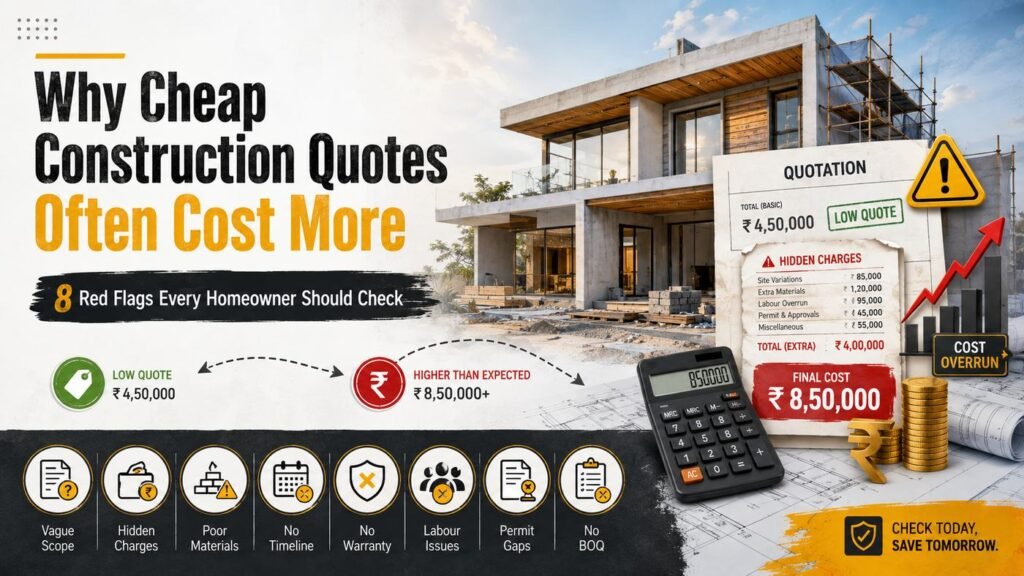
A low construction quote can look attractive, but payment terms often reveal more than the headline rate.
- Very large advance: Requested before site work begins.
- No written breakup: First payment is not linked to a clear scope.
- Date-only payments: Money is due by date rather than by actual progress.
- Missing material specs: Approved brands and grades are unclear.
- Frequent urgent extras: Additional money is requested without written approval.
- No payment record: Receipts or invoices are not provided.
- Unclear delay responsibility: Agreement does not explain what happens if work stops.
How Homeowners Can Track Every Payment
You do not need a complicated client portal to maintain financial control over your project.
A simple payment tracker can work very well.
For Every Payment, Record
- Date
- Amount
- Construction milestone
- Work completed
- Payment mode
- Receipt or invoice reference
- Photos of the relevant site stage
- Any pending work linked to that milestone
Keeping this record on WhatsApp, a spreadsheet, or a shared project file gives you a clear history of the project.
Which Payment Structure Is Safer?
For most plot owners, the safest arrangement is not the one with the smallest first payment or the largest first payment.
The safer structure is the one where payments are transparent, documented, and connected to progress.
A Good Structure Should Provide
- Enough cash flow for genuine construction activity
- Protection against excessive upfront exposure for the homeowner
- Clear material and scope commitments
- Regular milestone verification
- Written approval for additional costs
- A visible balance between money paid and work completed
Conclusion
Before signing a turnkey construction agreement, do not judge payment safety only by the total quoted price. Understand when you will pay, why you will pay, and what construction milestone should be achieved against each payment.
- Avoid heavy unexplained upfront fees.
- Link major payments to measurable construction stages.
- Keep material specifications and exclusions in writing.
- Record every payment and project change.
- Never release major additional amounts without understanding the reason.
Planning to Build Your Home?
Share your plot size, location, and required number of floors with The Home Construction team for a transparent, stage-wise project quotation.
WhatsApp: +91 84488 02364